Evolve With AI
A courtroom-themed landing page for a satirical AI-operator show, with a self-generating lead-magnet PDF pipeline, an email-gated toolkit, and an evidence-discipline standard…
Problem
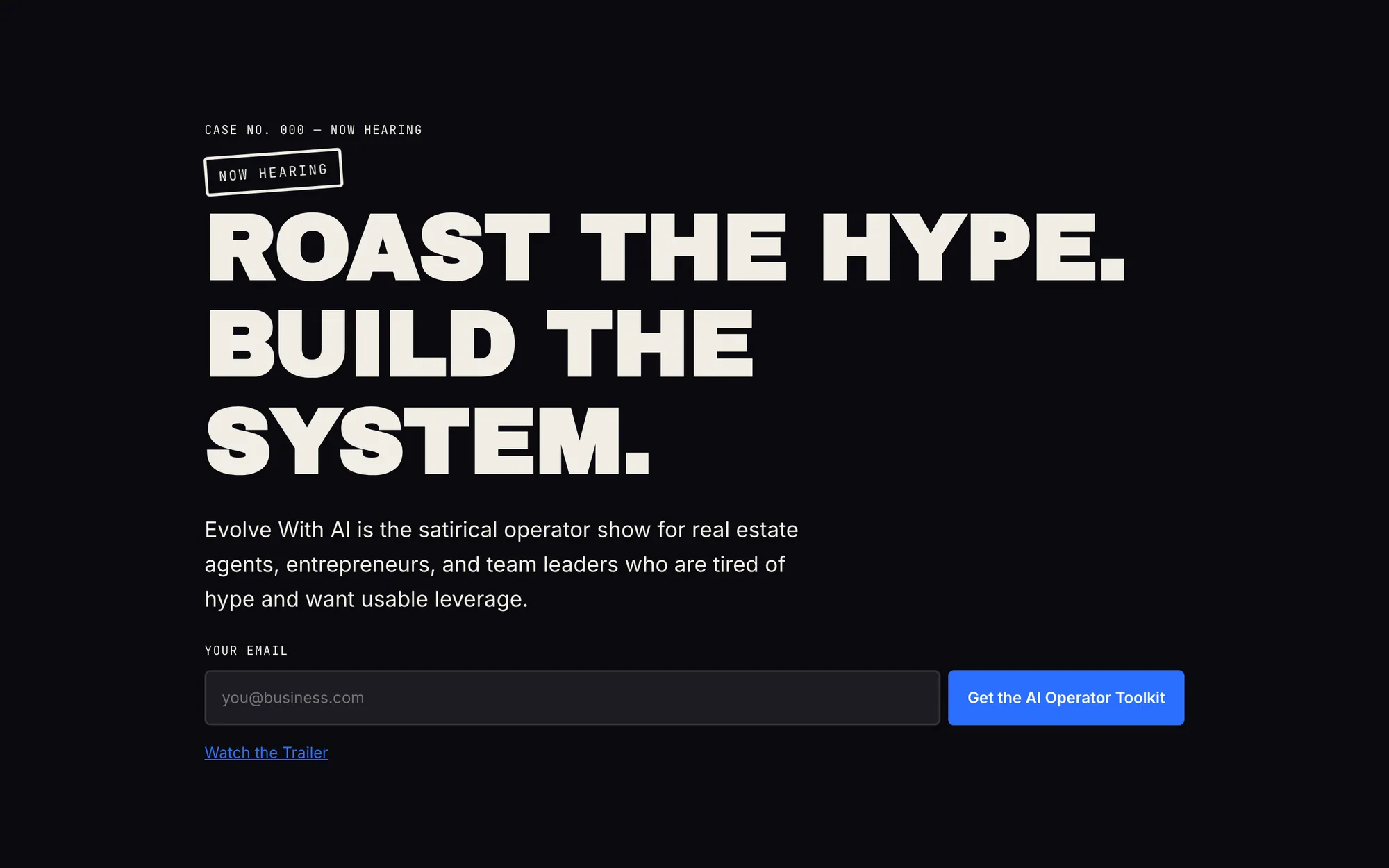
Evolve With AI needed a landing page for a satirical AI-operator show aimed at real estate agents and entrepreneurs tired of AI hype, one that could carry a distinct courtroom-trial visual identity strong enough to differentiate from generic SaaS landing pages, deliver a real lead magnet (not a placeholder), and hold together under real content pressure as a twelve-episode season and its supporting research got produced against it. The show's own premise raised the stakes on the site: a season built around a single running thesis about AI hype is one unsourced number away from losing its credibility to a commenter, so the writer's room had already committed to an evidence standard — every claim needs a name, a number, or an archived document, and a missing source means the episode slot gets swapped rather than filled with a plausible-sounding figure. The landing page had to reflect that same discipline rather than undercut it: a lead magnet that was gated and real, episode content that stayed unpublished until locked against verified research, and a design system distinctive enough to read as "trial," not as another SaaS template, for an audience the show explicitly targets as people already fatigued by generic AI marketing.
What was built
A static Astro site with one dynamic element: a Cloudflare Pages Function that captures email addresses, creates a Resend contact, and sends a toolkit-delivery email. The page is built entirely around 'The Docket' design system, a courtroom case-file aesthetic with numbered docket tabs per section, courtroom stamp components (GUILTY / EXHIBIT / APPROVED), and a strictly reserved verdict-green color used nowhere else on the page. The lead magnet is a 7-template 'AI Operator Toolkit' PDF, generated automatically from a source Astro page via a Playwright screenshot pipeline and gated behind email capture rather than linked publicly. Season 1 content (episode titles, theses, toolkit pairings) is data-driven from a single typed source file so the landing page and toolkit stay in sync as episodes get written; each episode entry carries a placeholder flag so an episode's title and thesis can exist in the data model without being locked or shown as final, and the episode count directly controls how many exhibit stamps render on the page, enforced by an invariant test rather than left to drift.
Technical approach
The build has no server beyond one Cloudflare Pages Function (functions/api/subscribe.ts); everything else is static Astro output. The subscribe flow is deliberately split into a pure, unit-testable request-builder module (_subscribe-core.ts, no Cloudflare globals) and a thin handler wired to the runtime, which lets the request-shaping logic (email validation, honeypot check, Resend payload construction) be tested without mocking the Cloudflare Function environment. The honeypot field silently short-circuits to a fake success response rather than a visible rejection, and the Resend contact-creation call treats a 409 (duplicate subscriber) as success while the actual toolkit-delivery email call is the one blocking step that can fail the request. The PDF pipeline is a genuinely engineered build step, not a manual export: scripts/build-toolkit-pdf.mjs spawns an astro preview server, polls a dedicated /toolkit-print route until it returns 200, drives headless Chromium via Playwright to render it and wait for network-idle, then calls page.pdf() at Letter size with forced background colors so the dark courtroom theme survives into print. That print-only route is stripped from the production build by a separate build:pages script (verified by a dedicated test) so the toolkit is reachable only via the delivery-email link, not by guessing the URL. The design system enforces its own discipline mechanically: tests/invariants.test.ts asserts the docket-tab numbering stays 001-006 in order, that stamp counts and aria-hidden usage match the design brief, and that the page carries exactly one h1, turning the design spec into a build-blocking regression check rather than a document that drifts. Content fidelity for the toolkit templates is treated with unusual rigor for marketing copy: the design docs record a specific historical failure (accidental character substitution during a copy pass) and now require character-for-character fidelity to the source-of-truth markdown, including preserved typographic punctuation.
Creative approach
Craft
The Docket system frames the entire page as an active case file: a near-black void background (#0A0A0F), case-cream text, electric blue as the general-purpose accent, and a single reserved neon verdict-green (#39FF14) that appears in exactly two places on the live page (the approved/exhibit stamps and one email-capture success state) and nowhere else, enforced as an explicit rule rather than a convention. Archivo Black in forced uppercase carries all headings and stamp labels, Inter carries body copy, and JetBrains Mono in uppercase with wide letter-spacing renders every docket reference, case number, and exhibit label, giving the page a consistent bureaucratic-legal texture. Each landing-page section opens with a manila-folder-style docket tab numbered like a real case docket (CASE NO. 001 through 006), which does double duty as navigation scaffolding and as the joke: AI hype is literally being put on trial, one exhibit at a time.
Reframe
The non-obvious move was applying journalism-grade evidence standards to a comedy format, on the theory that a satire show arguing one thesis across a season loses more credibility to a single disprovable number than it gains from any joke. The show's own rule set requires every claim to carry a name, a number, or a document with an archived source, forbids inventing evidence even when a 'plausible figure' would smooth a script, and requires swapping an episode's slot entirely rather than writing an argument the research can't support. That discipline shows up on the site as the gated, real (not sample) 7-template toolkit, and as the deliberate refusal to publish episode titles or theses until they're locked against verified research.
Process and what failed
The commit history documents genuine editorial reversals in the writer's room feeding this site: a fact-pass on episode 1 catching what the log calls a 'fourth fake' claim before it could ship, an explicit voice-system installation that resolved four of six identified conflicts while accepting the other two as open tradeoffs rather than forcing consensus, and a rule ('the reverence rule') adopted mid-season specifically because a prop (a lockbox) was reshot after the team learned that showing the real object mattered more than a generic stand-in. A parallel technical thread shows the team fixing its own toolkit content pipeline after catching an inadvertent character-substitution bug that had silently corrupted copy fidelity, then hardening the process with an explicit character-for-character rule going forward.
Outcome
Live at evolvewithai.us as a static Astro site on Cloudflare Pages. The lead-magnet toolkit and email-capture flow are functioning production systems (Resend contact creation, gated PDF delivery, Turnstile spam protection), and Season 1 production was actively underway through August 2026 per the commit history, with three episodes locked and live at last verification (Exhibit A through Exhibit C, locked 2026-07-07 against the show bible) and the remaining season in active scripting under the same evidence-standard rules. The three locked episodes each carry a matched toolkit template out of the seven-item Toolkit — Call Deconstruction Template, One Video Five Assets Prompt, and AI Agent Starter Stack — so the landing page's episode cards and its lead magnet stay paired one-to-one rather than the toolkit outrunning the show or vice versa. The PDF pipeline and its safeguards are load-bearing rather than decorative: a dedicated test asserts the generated PDF is a non-trivial file that actually starts with a %PDF- header, and a separate meta-test asserts the production build strips both the test output and the print-only source route, so the only path to the toolkit stays the gated email-delivery link even after multiple build iterations.