Diaz Family Reacts
A family YouTube reaction channel built end-to-end from a single planning zip to a live channel-hub site, a scheduled 113-item content calendar, and a kid-safety framework that…
Problem
The Diaz family had a channel concept — parents and kids reacting to classic and modern movies and TV, structured around whether Dad's nostalgia holds up to the kids' honest judgment — but no operational system to run it. Family YouTube content carries two structural risks that most channel launches skip past: YouTube Content ID can flag reaction footage regardless of fair-use merit, and putting kids on camera means every editing and comment-moderation decision needs a consistent, non-negotiable safety framework rather than case-by-case judgment calls made under launch-week pressure. A third risk sits underneath both: YouTube's made-for-kids (COPPA) classification has to be set correctly at both the channel and per-video level from the first upload, and getting it wrong either invites the wrong audience or strips features the channel needs — a decision that needed a standing rule rather than a guess made per video.
What was built
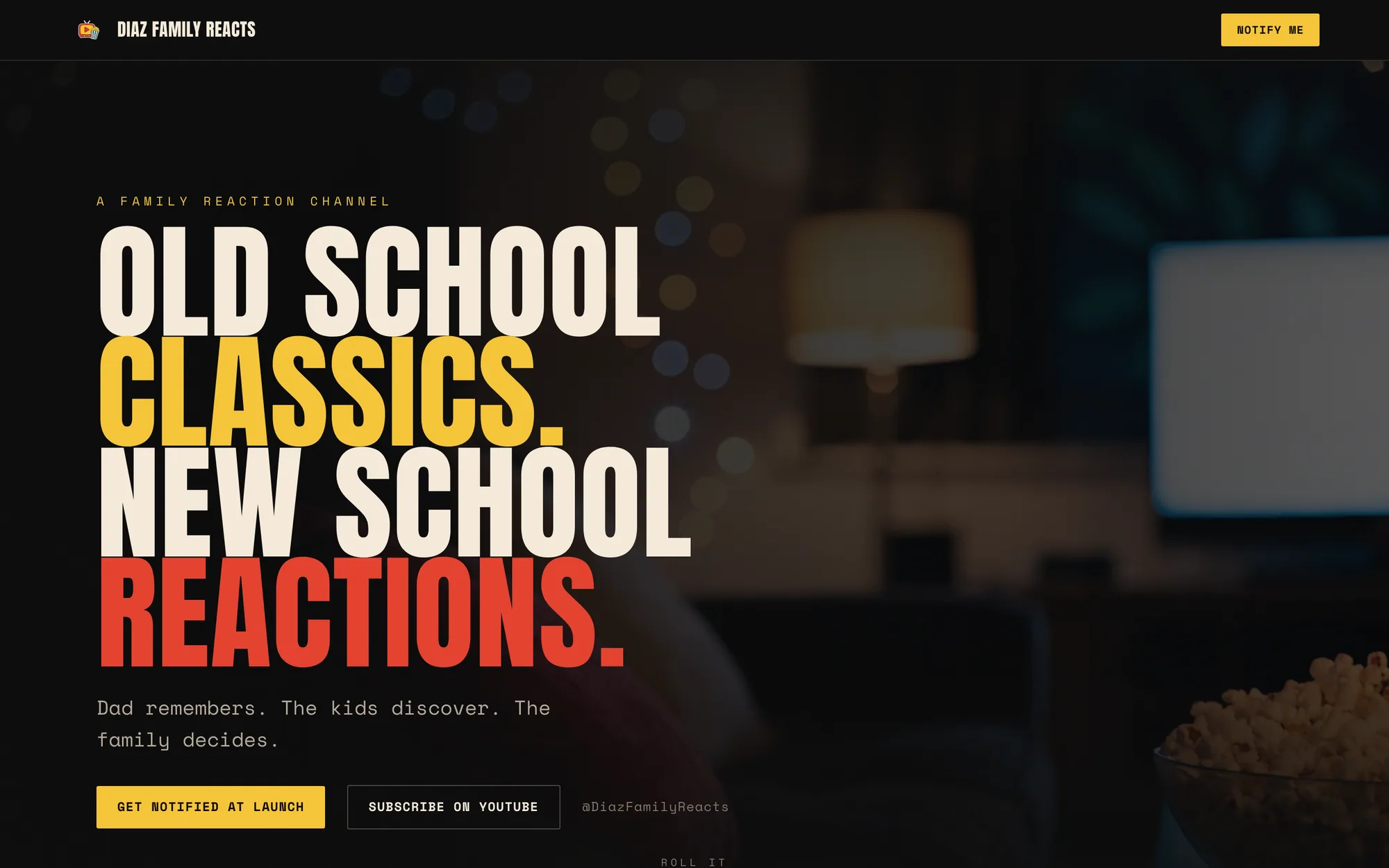
A production repo that scaffolds each episode into a standard folder structure (raw footage, audio, project file, exports, thumbnail, Shorts, notes) with format-correct run-of-show and pre-filled notes, plus a signature recurring mechanic — the "Diaz Scale," a 1-10 rating each family member gives at the close of every episode, which sorts titles into a Hall of Fame or Never Again list and is designed as the thing viewers argue about in comments. A companion channel-hub website launched live at diazfamilyreacts.com with a big-type editorial design, cinematic AI-generated video backgrounds on every section, and an email capture wired to a Resend "Launch Notify" audience. A 113-item master content schedule was generated and mirrored into Google Calendar as a planning-only artifact — nothing auto-posts — alongside a weekly Monday-morning briefing routine to keep the launch deadlines visible. Four episodes were fully prepped (titles, descriptions, thumbnail briefs, 20 Shorts total) ahead of a targeted July 27 launch.
Technical approach
The website is a Cloudflare Pages project with API Functions for the subscribe endpoint, and it has a specific deploy trap that got documented after being hit: deploying from the repo root instead of from inside the website/ subfolder silently skips the Functions bundle, so the subscribe API 405s and the site quietly serves a static index with no working form — the fix is deploying from inside website/ and confirming the build log shows both "Compiled Worker" and "Uploading Functions bundle." The Cloudflare API token used for this repo is scoped to Pages/Workers/D1/account-read only, with no Zone:DNS or Rulesets access, so DNS changes and redirect rules for the site and its second parked domain are manual dashboard steps, not automatable — a constraint discovered and worked around rather than assumed away. The content schedule is generated by a Python script (gen_schedule.py) that writes both CSV and markdown calendars and is explicitly one-way: it produces a planning artifact, not a posting integration, so there's no risk of content going out on a schedule nobody reviewed. Kid safety and copyright rules are encoded as "non-negotiable" directives inside the repo's always-loaded CLAUDE.md, which any Claude Code session reads automatically — meaning content-generation prompts (titles, descriptions, Shorts ideas) are constrained by the same rules whether Victor is present to catch a violation or not, rather than relying on manual review to catch every case.
Creative approach
Craft
The site design is a deliberate departure from a safe default: the initial recommendation was video background on the hero section only, but the actual build put a cinematic Higgsfield-generated video background behind every section, with a heavy scrim, film grain, lazy-loading, and a static poster fallback for reduced-motion and mobile — a user override of the more conservative recommendation, executed with the performance and accessibility guardrails that override implies. Big-type editorial typography (marquee/poster style, referencing Monotype's "Sound & Vision") carries the retro-movie-night premise visually rather than through stock photography, built on self-hosted fonts and a five-color theater palette — black, popcorn yellow, marquee red, cream, retro-blue — with the Diaz Scale itself rendered as the site's signature element: a giant scroll-revealed type ladder counting 10 down to 1 that puts the channel's rating mechanic directly into the page's motion design rather than treating it as an incidental content detail. Site copy is constrained to ASCII only, since em/en dashes silently break the Cloudflare Pages deploy pipeline this project ships through.
Reframe
The Diaz Scale is the structural insight: instead of a single review or reaction, every episode closes with four separate family scores that combine into one average against fixed thresholds (8.5+ enters the Family Hall of Fame, below 5.5 lands on the Never Again List), which does two things at once — it gives viewers something concrete to disagree with in the comments (a wrong call is memorable and arguable), and it gives the production team a built-in Shorts and quote-graphic generator, since a surprising or lopsided score is inherently shareable without extra creative work. The second reframe is on the safety side: comment-moderation rules are written as pattern-and-category directives ("hold comments about a child's appearance or location") rather than as an exhaustive blocked-word phrase list, specifically because a fixed list is a losing game against how people phrase things, while a category rule catches variations a list-based filter would miss and doesn't need to be maintained forever.
Process and what failed
The copyright posture was worked out as an explicit tradeoff rather than assumed: minimize copyrighted footage, keep the family as the main visual event, and plan a backup edit format for every episode before it uploads, because Content ID can flag reaction content independent of whether it would win a fair-use argument — the claims tracker exists specifically to log what actually gets flagged after the fact rather than relying on a pre-upload guess. During the build, the Higgsfield MCP connection dropped mid-session once and had to be reconnected, a small but real interruption to the automated background-generation workflow that got logged rather than silently retried.
Outcome
The website is live at diazfamilyreacts.com with a working email-capture pipeline into a Resend launch-notify audience, and the YouTube channel (@DiazFamilyReacts) was created with the site's subscribe links resolving to it. Four episodes were fully scripted and publish-pack-ready ahead of a July 27, 2026 target launch. A second parked domain was attached to the same Cloudflare Pages project as a backup route, though its DNS swap remained an owner-only manual step at handoff, same as Web Analytics enablement, which the deploy token isn't scoped to touch. As of the last recorded handoff, filming and editing the trailer and first episodes remained outstanding owner-only work — this is an operational and web build completed ahead of content production, not a channel with published episodes or audience numbers yet.